
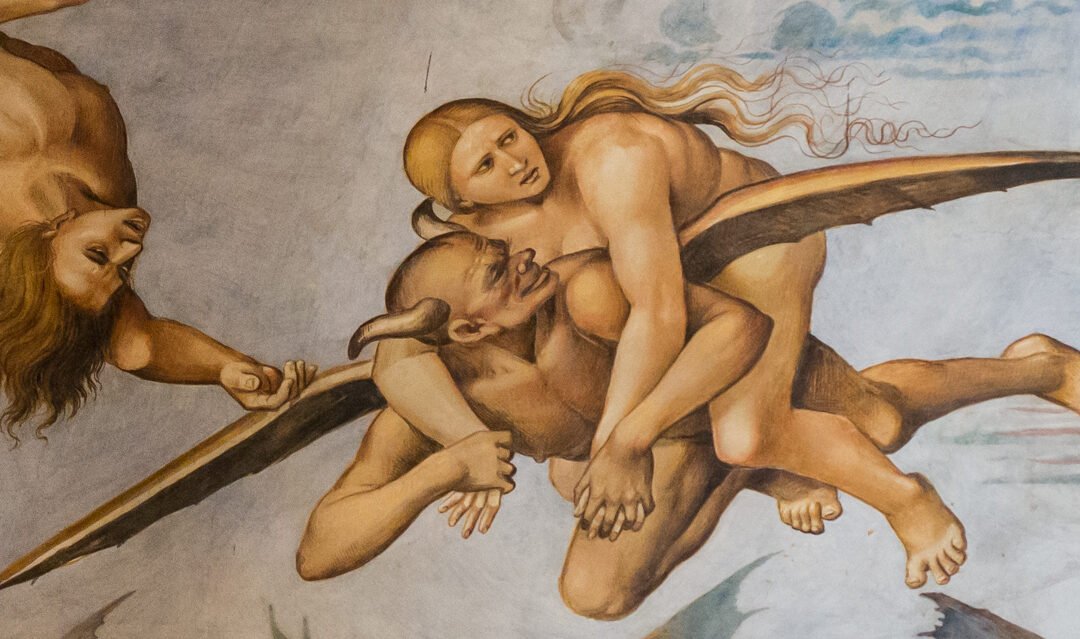
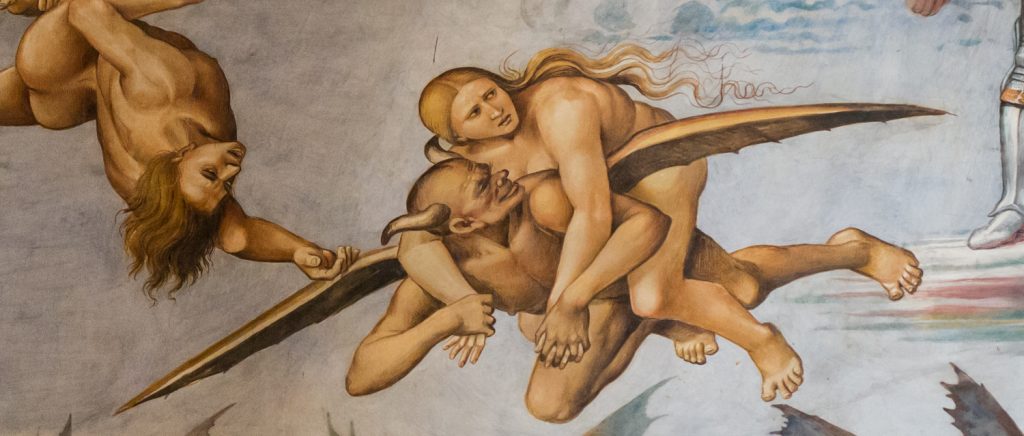
A fallen woman flying on a devil’s back, one of the images by Signorelli that so stimulated Freud
Freud, Orvieto and Signorelli
Freud, Orvieto, Signorelli: the Renaissance frescoes by Luca Signorelli had a profound effect upon Freud. In the entrance hall of Freud’s last home in London, on the right, is a picture of Tivoli, a reminder that Italy was his favourite holiday destination and his spiritual home.
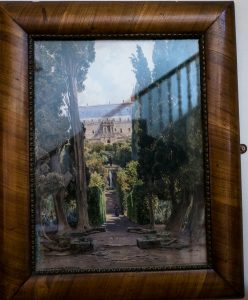
Gardens of Villa Este, Tivoli
50 years after his death in London a collection of black and white Italian postcards was found in a drawer. Purchased during his first of three visits to Orvieto in 1897 they depict frescoes by Luca Signorelli from the San Brizio Chapel in Orvieto cathedral. His encounter with the Renaissance artist from Cortona had a profound effect upon him that profoundly influenced his life and work.
When Freud arrived in Orvieto in 1897 he was going through a turbulent period for several reasons: he was mourning his father who had died in December; partly as a result of this he was in the process of jettisoning his conclusion that hysteria was caused by paternal seduction in childhood turning instead towards the idea of infant sexuality; curiously, the man who sought the source of almost everything in sex had recently set out on a life of celibacy after siring six children in nine years. Furthermore, starting two years before, he had embarked upon self analysis, then an uncharted journey into the unknown, and just the year before, in 1896, he had coined the term psychoanalysis.
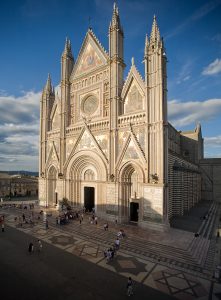
Orvieto Duomo and Stars of David
The vaulted ceiling was gorgeously painted by Fra Angelico the Dominican friar in purple and gold in the mid 15th century. He abandoned the project after his favourite assistant fell to his death.
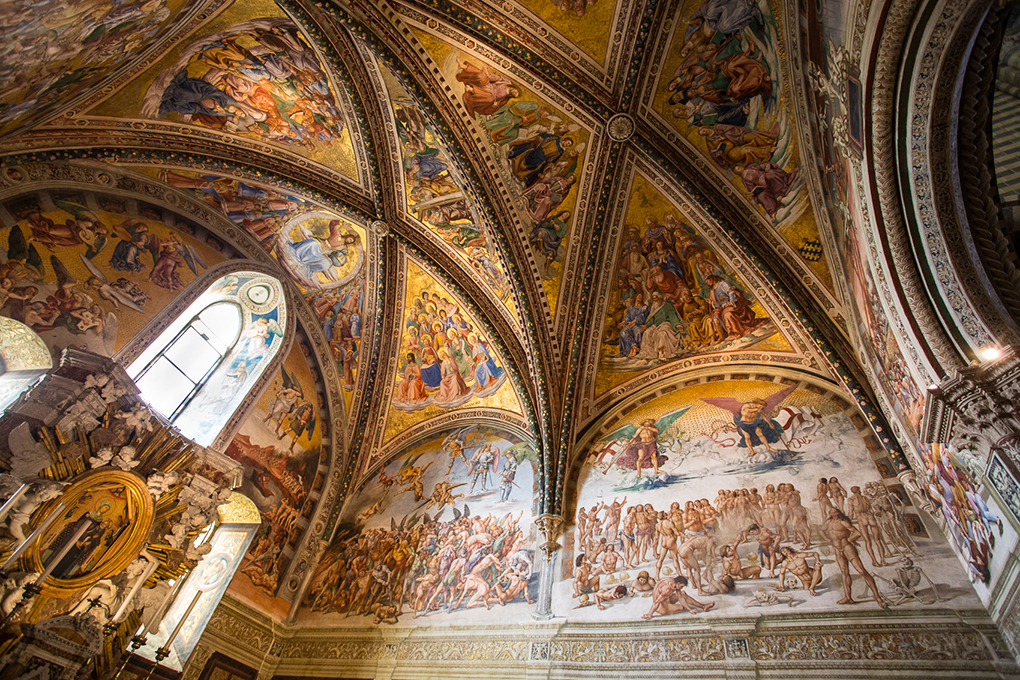
The wonders that Freud saw when he walked into the San Brizio Chapel in Orvieto Cathedral. The frescoes on the ceiling were started by Fra Angelico and completed by Signorelli in the same early Renaissance style. Those on the walls are entirely Signorelli’s creation.
The frescoing of the walls was undertaken by Luca Signorelli in 1499 aged about 54. Signorelli’s vision is an apocalyptic view of the end of the world. If music were added, and there are from time to time musical performances, then this is what the Germans would describe as a Gesamtkunstwerk, a complete work of art. Indeed, musicians feature in several of Signorelli’s panels.
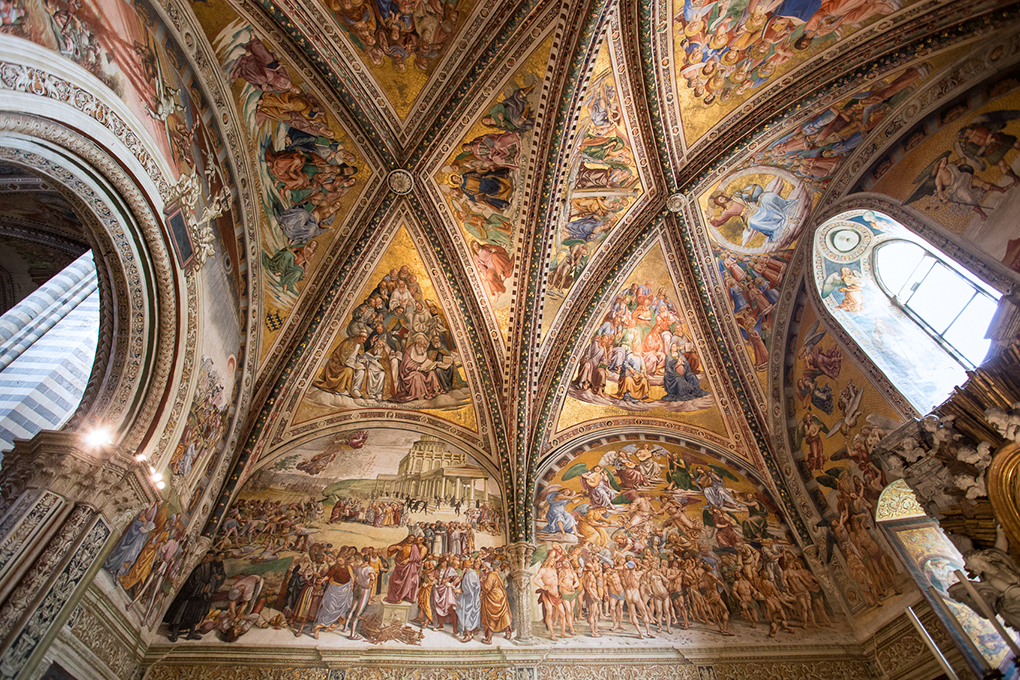
The Antichrist panel left and the Elect in paradise right. Fra Angelico frescoes above on the vaulted ceiling.
On the left is the preaching of the Antichrist followed by the elect cavorting, largely naked, in paradise.
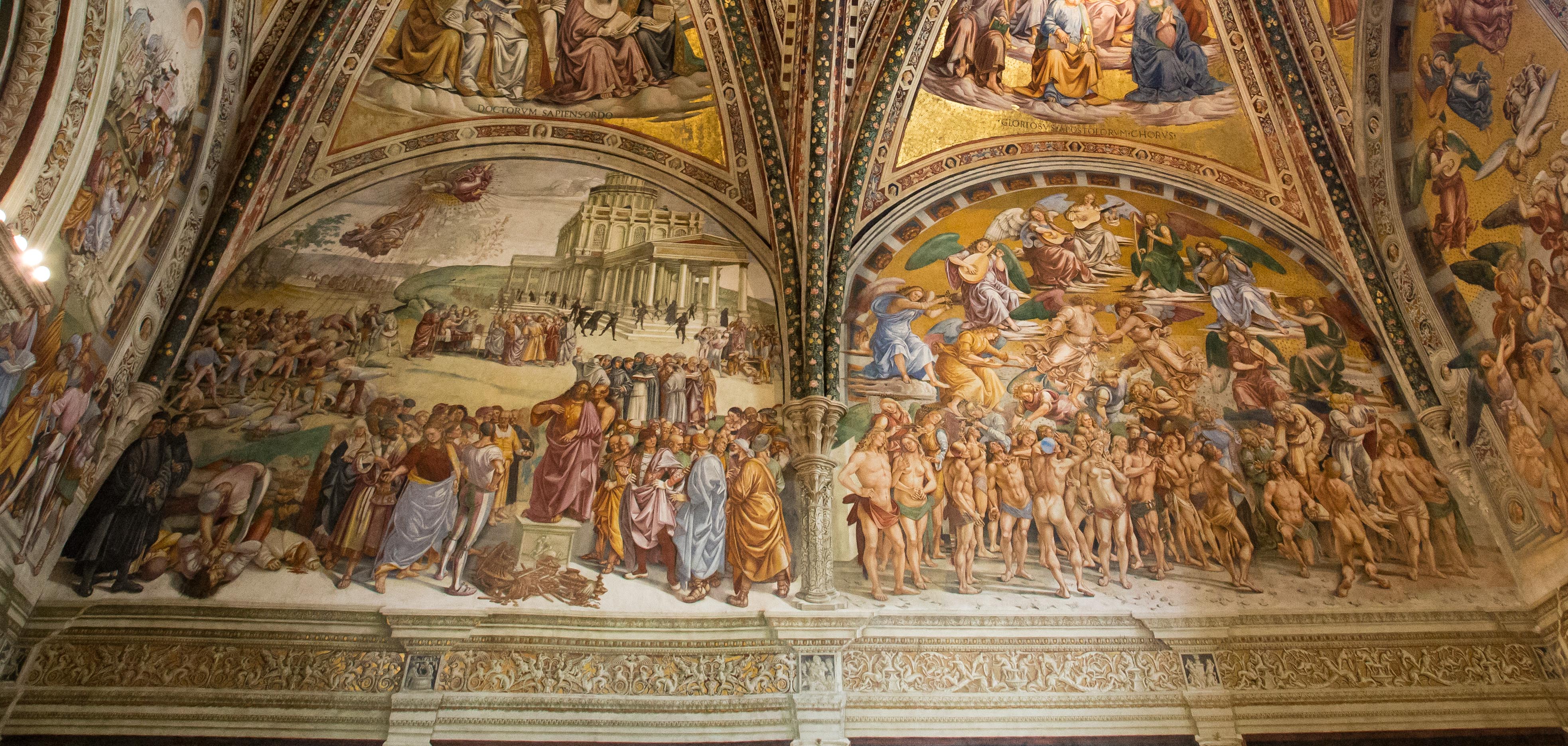
The Antichrist tableau left and the Elect in Paradise right. The Bottom left corner are Signorelli himself left with hat and a friar, generally supposed to be Fra Angelico behind, both wear black.
Other walls and lunettes show scenes of angels smiting the ungodly with death rays – in fact there is a lot of smiting going on all over the chapel, a veritable orgy of sex and violence.
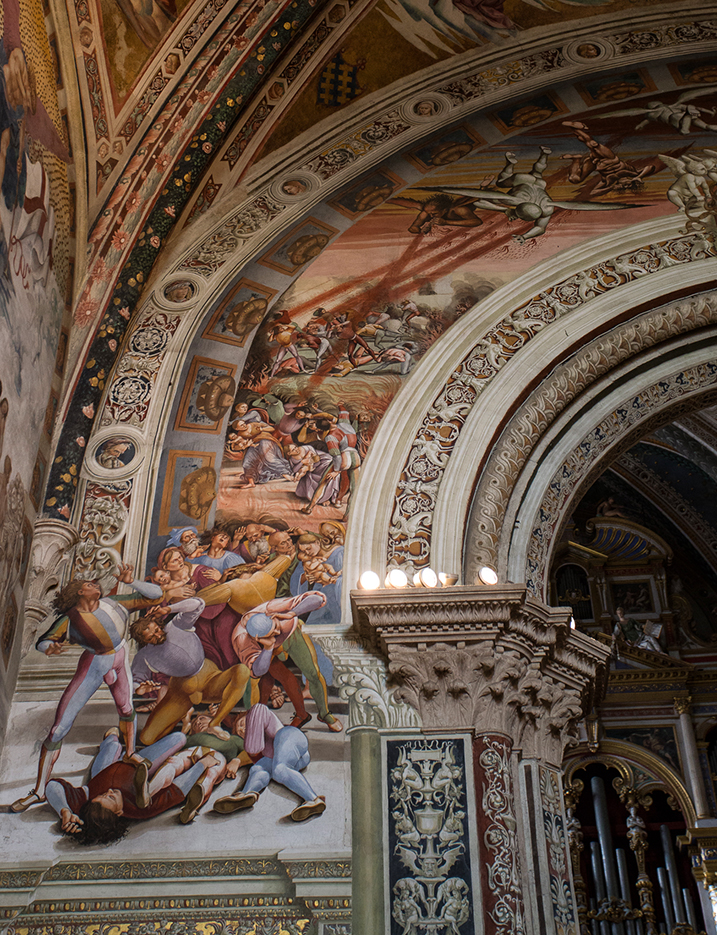
the wicked smitten by death rays from on high
On the wall opposite are two tableau, both a riot of eroticism and naked flesh, not perhaps what what one would expect in a church, the damned thrown into inferno by devils followed by the saved hauling themselves up from their graves to eternal life.
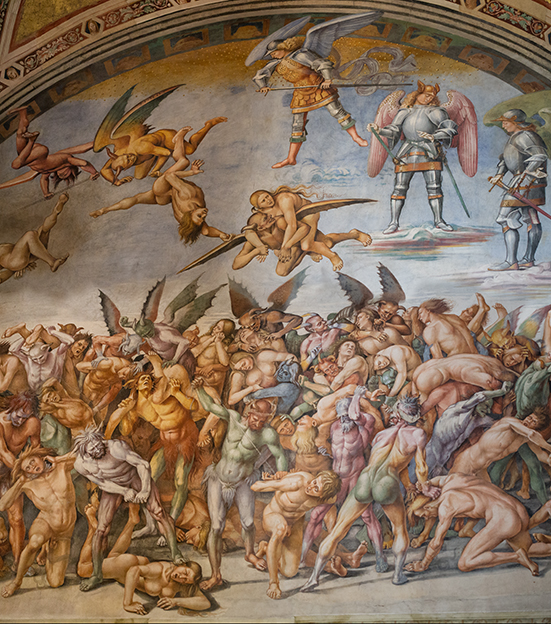
The damned thrown into hell.
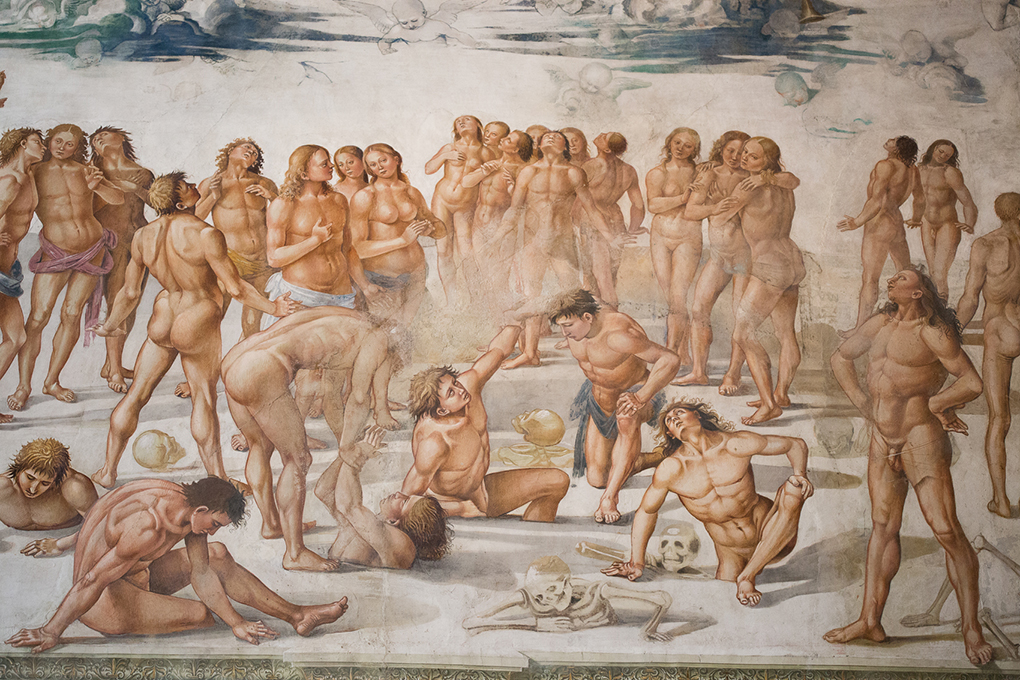
The resurrection of the dead
The tableau that seems to have exerted the greatest fascination upon Freud is the Antichrist. An unusual subject, it was commissioned by the powerful Monaldeschi, a Guelf family, always close to the papacy and in opposition to the Ghibellines who supported the Emperor; the scene is a polemic against heresy, especially the Cathars who had been particularly bothersome in Orvieto, but also against Jews.
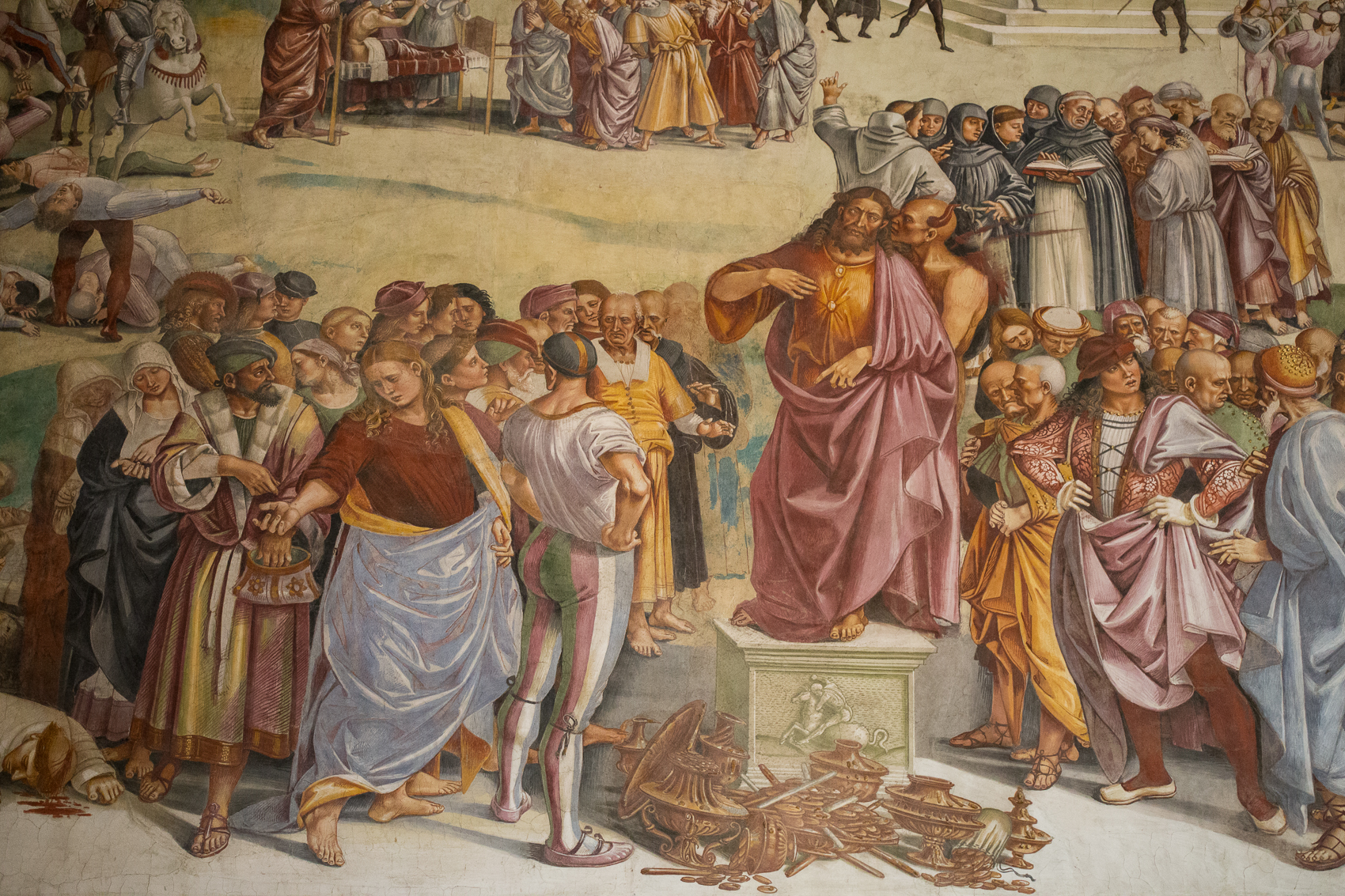
The devil whispers to Antichrist, possibly based on Savonarola although he could be said to have Jewish features.
Freud had been aware of antisemitism since his childhood in Moravia when his father had told his young son that he had humbly turned the other cheek when accosted by an aggressive antisemite on the street. Ever since, Freud had admired more martial father-figures like Cromwell, Hannibal and significantly, Moses.
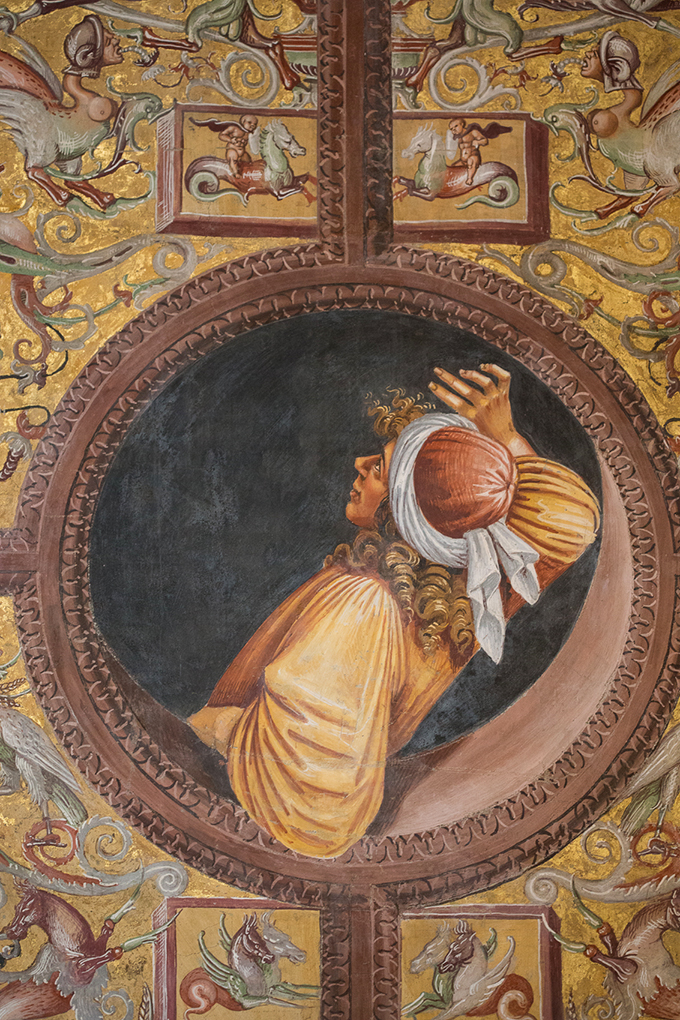
A spectator watches the mayhem above. He is surrounded by ‘grotesques’, painted just after the recent discovery of the grottoes of Nero’s Domus Aurea in Rome.
The Catholic Church at the time saw Jews not merely as infidels, but Jesus-killing heretics. Freud, who was suffering emotional and intellectual turmoil after his father’s death, stood surrounded by Signorelli’s apocalyptic maelstrom and saw the son, Christ, effectively slaying the father, Judaism.
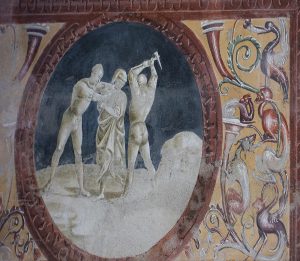
A smitten Dante figure
“I saw before my eyes with especial sharpness, the artist’s self portrait next to his predecessor in the work…”
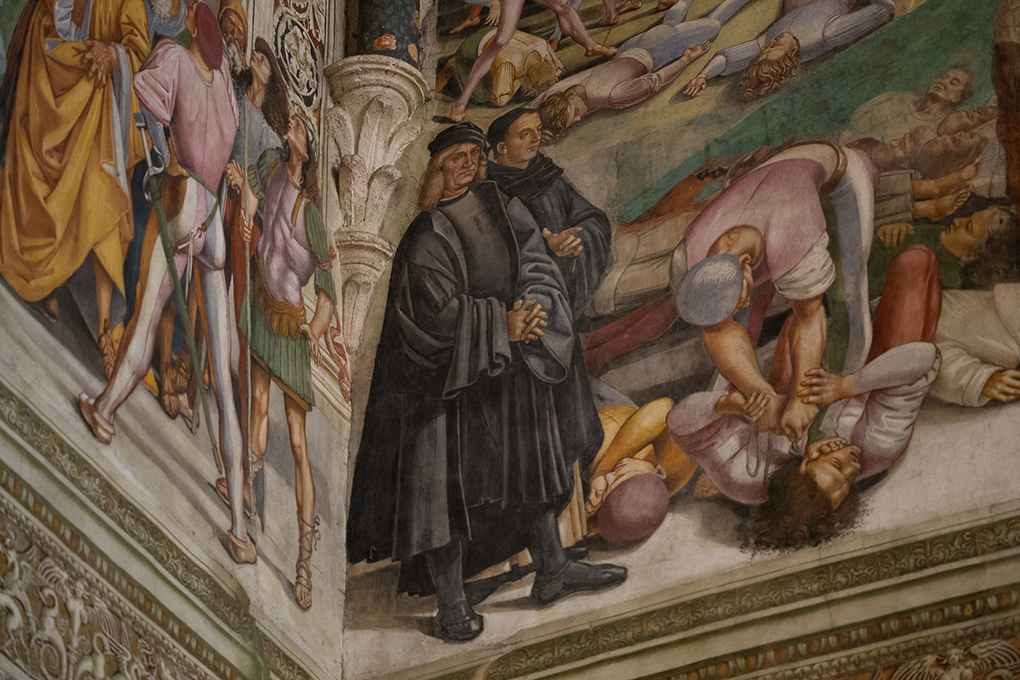
Self-portrait of Luca Signorelli surrounded by mayhem looks out of the frame. Behind him stands Fra Angelico or perhaps not – it could be the Archdeacon.
Trackbacks/Pingbacks